How Solar Drying Machines Support Modern Food Dehydration
Wiki Article
Introduction
Food processing businesses often need to balance production capacity, product quality and operating costs. Drying is one of the processes where energy use can become important, particularly when conventional thermal systems are used frequently.
Solar food processing dryers offer another approach for suitable products. They use solar thermal energy to assist moisture removal while providing an enclosed environment for product handling.
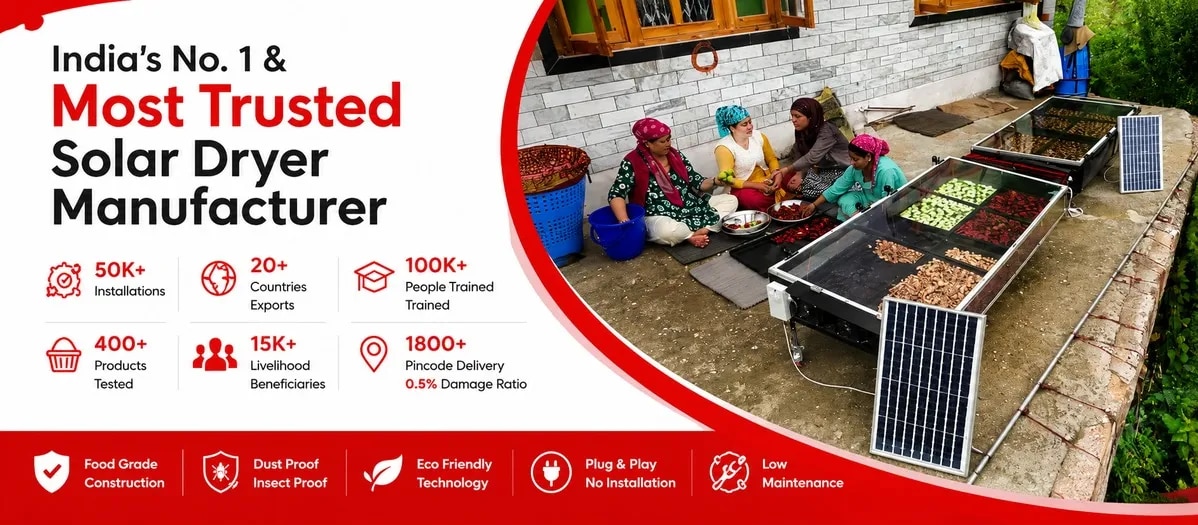
Rudra Solar Energy offers a solar food processing dryer designed for suitable prepared fruits, vegetables, herbs, spices, grains, pulses and other compatible food ingredients. The company states that configurations range from 5 kg per batch to 500 kg per batch.
What Is a Solar Food Processing Dryer?
A solar food processing dryer is a drying system designed for food ingredients and agricultural materials. Products are placed inside a drying chamber and exposed to heated air generated through solar thermal energy.The objective is to reduce moisture according to the requirements of the particular product.
Why Enclosure Matters
Enclosure separates the product from the open outdoor environment. Rudra Solar Energy describes its solar drying systems as hygienic, enclosed systems intended to reduce direct exposure to dust, rain and pests. :contentReference[oaicite:56]index=56This does not replace food safety procedures, but it can support more organised processing.
Preparing Food Before Drying
Preparation can strongly affect drying performance. Depending on the product, preparation may include cleaning, cutting, slicing, peeling or sorting.The product should be prepared consistently so that pieces with similar characteristics are processed together.
Slice Thickness and Surface Area
Thin slices generally present more surface area relative to their volume than thick pieces. This can influence moisture movement.Rudra Solar Energy notes that slice thickness, product preparation and loading can affect drying performance.
Products for Solar Food Processing
The solar food processing dryer can be considered for suitable fruits, vegetables, herbs, spices, grains and pulses. :contentReference[oaicite:58]index=58Other solar dryer models from Rudra cover additional agricultural categories, including oilseeds, seeds, flowers and fish.
Different Products Need Different Processes
A processor should not assume that every commodity can be dried using one standard recipe.The operator should establish appropriate loading, temperature, airflow and endpoint criteria for each product.
Commercial Batch Planning
A food processor should understand its raw-material supply before selecting machine capacity.Rudra's solar dryer range extends from 5 kg per batch to 500 kg per batch, allowing different processing scales to be considered.
A useful planning exercise includes:
- Daily fresh material availability
- Peak seasonal volume
- Desired batch size
- Number of batches
- Available processing space Click Here
- Packaging capacity
- Labour requirements Solar Dehydrator Machine
- Need for backup heating
Energy Considerations
Solar drying can reduce dependence on conventional energy where those sources are currently being used. Rudra Solar Energy states that its systems are intended to reduce recurring fuel or electricity costs in appropriate applications. :contentReference[oaicite:61]index=61However, the actual savings depend on the application. If the previous process already relied on free open sunlight, there may be little direct fuel saving.
Backup Systems
Rudra lists optional electric or biomass backup for suitable solar dryer configurations. :contentReference[oaicite:62]index=62Businesses that require more predictable operation can evaluate whether such a configuration is appropriate.
Food Quality and Packaging
Drying is only one stage in producing a finished food product. The material should be cooled appropriately and packaged to protect it from moisture and contamination.Packaging requirements depend on the product and intended storage Solar Dryer Supplier conditions.
Maintaining Consistency
A processor can keep batch records to track product quantity, preparation, drying conditions and final observations.This can help identify variations and improve process consistency.
Cleaning and Maintenance
Food processing equipment should be cleaned and inspected regularly. Trays and food-contact surfaces require appropriate sanitation.The chamber, glazing and airflow components should also be maintained according to the manufacturer's instructions.
Conclusion
Solar food processing dryers provide an option for businesses that want to use solar thermal energy for suitable dehydration applications. Rudra Solar Energy offers food-processing dryer configurations from small batch applications through larger capacity requirements. :contentReference[oaicite:63]index=63The most important factor is not simply the size of the dryer but its suitability for the product and workflow. Preparation, loading, airflow, moisture, solar conditions, hygiene, packaging and storage all influence the process.
For food businesses evaluating solar drying, a product-specific assessment can help determine the appropriate equipment and operating method. Solar technology can then become one part of a structured food-processing system rather than an isolated piece of equipment.
 Report this wiki page